· blog · 5 min read
From Insights to Action: Turning Client Data into Revenue Opportunities
Client balances, transactions, holdings, cash positions, and risk profiles are already available in most systems. Yet in practice, this information often remains fragmented, underused, or only reviewed during scheduled reporting cycles.

Most wealth management firms are not short on data. They are short on actionable outcomes from that data.
Client balances, transactions, holdings, cash positions, and risk profiles are already available in most systems. Yet in practice, this information often remains fragmented, underused, or only reviewed during scheduled reporting cycles.
The result is a persistent gap between what firms know and what they do. And that gap represents one of the largest untapped revenue opportunities in wealth management today.
Data Is Not the Advantage Anymore
Over the past decade, firms have invested heavily in data infrastructure. CRM systems, reporting tools, portfolio platforms, and aggregation layers are now standard.
But access to data is no longer a differentiator.
The real question has shifted from: “Do we have the data?” to “Can we act on it in time to create value?”
According to McKinsey & Company, the economics of financial advice are being reshaped by technologies that reduce the cost of producing insights. This shift increases pressure on firms to translate information into client outcomes, not just reporting outputs.
Where Revenue Is Hidden in Client Data
Client data is not just operational. It is directional. It signals where value is being created or lost.
In most advisory books, revenue leakage happens in predictable places:
1. Idle Cash Positions
Clients often hold excess cash that is not proactively addressed. This represents an immediate, deployable AUM opportunity.
2. Portfolio Drift
Over time, portfolios naturally move away from target allocations. Without monitoring, this drift goes uncorrected.
3. Uncaptured Life Events
Changes in income, liquidity, or behavior often appear in financial data before they are discussed directly with an advisor.
4. Fragmented Asset Views
Assets held outside the main advisory relationship reduce visibility and limit cross-sell opportunities.
Individually, these issues appear minor. Combined, they represent a significant loss in both revenue and client lifetime value.
Why Most Firms Fail to Act on Their Data
The challenge is not data availability. It is an operational structure.
1. Data Exists in Silos
Client information is often spread across CRM systems, portfolio tools, custodians, and reporting platforms. Without unification, it is difficult to form a complete view of the client.
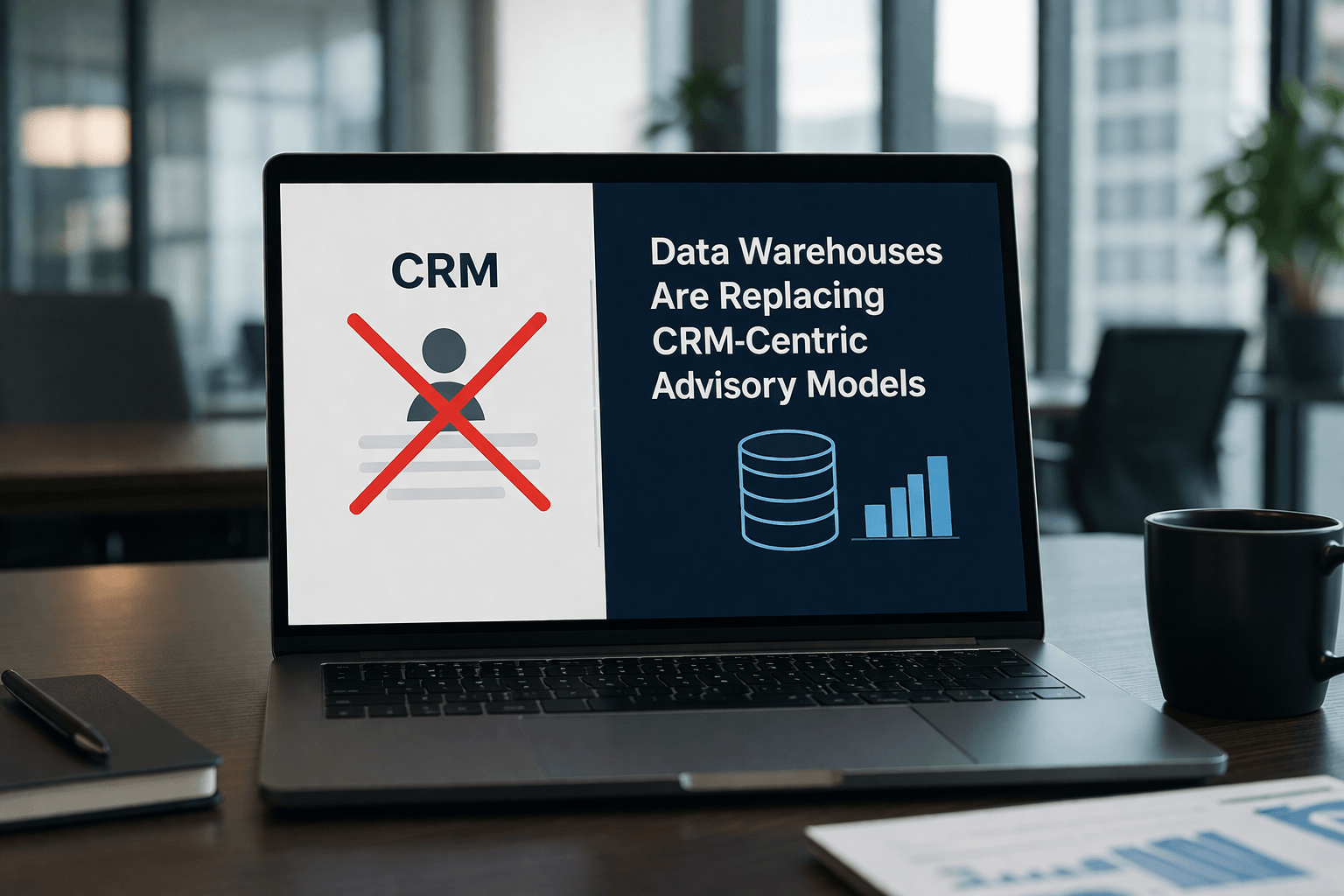
This challenge is a key reason why firms are moving away from CRM-centric models toward integrated data architectures, as explored in Why Data Warehouses Are Replacing CRM-Centric Advisory Models.
2. Reporting Cycles Delay Action
Most client insights are surfaced during quarterly or annual reviews. By the time they are reviewed, the opportunity may already have passed.
3. Insights Are Not Prioritized
Even when data is available, it is not ranked by urgency or revenue impact. Advisors are left to manually decide what matters most.
4. Advisors Lack Time to Scale Insight Generation
High-quality client analysis is time-intensive. In practice, advisors prioritize relationship management over deep data analysis.
The Shift: From Reporting to Activation
Leading firms are beginning to rethink the role of client data entirely.
Instead of treating data as something to report on, they treat it as something that should trigger action.
This creates a shift from:
- Static reporting to continuous monitoring
- Manual analysis to automated signal detection
- Reactive advice to proactive engagement
According to Reuters, financial institutions are increasingly using AI to transform raw data into real-time guidance, enabling faster and more targeted decision-making.
What “Turning Insights Into Action” Actually Means
Turning client data into revenue is not about producing more dashboards.
It is about building systems that consistently answer three questions:
1. What is happening in the client portfolio right now?
Examples include cash accumulation above threshold, allocation drift beyond tolerance bands, or changes in contribution behavior.
2. Why does it matter?
Not all changes are meaningful. The system must distinguish noise from opportunity. A small drift may be irrelevant while a large cash position is not.
3. What should the advisor do next?
Insights must be paired with clear actions such as rebalancing recommendations, investment deployment suggestions, client outreach prompts, or planning conversations.
Without this final step, insights remain informational rather than financial.
From Insight to Revenue: A Simple Mechanism
When structured correctly, client data follows a clear value chain:
Data → Insight → Priority → Action → Revenue
Each step reduces friction between observation and execution. The key bottleneck is not data collection. It is the activation speed.
How Revenue Is Created From Better Data Activation
When firms successfully operationalize client data, the impact is measurable:
1. Higher Assets Under Management (AUM)
Idle or misallocated assets are identified and corrected faster.
2. Increased Advisory Activity
More frequent, relevant client conversations lead to more planning work and investment decisions.
3. Improved Client Retention
Clients who receive proactive, personalized insights are less likely to leave.
4. Greater Share of Wallet
Better visibility into client needs leads to consolidation of external assets.
Why This Matters Now
Wealth management is entering a phase where differentiation is no longer driven by access to products or markets.
It is driven by operational intelligence.
Firms that can systematically turn data into action will outperform those that rely on periodic reporting and manual workflows.
As highlighted in EY, the gap between client expectations and traditional service models continues to widen, especially as digital-first expectations rise across generations.
The Real Competitive Advantage
The firms that win in the next decade will not be those with the most data.
They will be the ones that:
- Detect meaningful client signals early
- Prioritize them based on impact
- Act on them consistently
- Scale this process across the entire client base
In other words, the advantage is not data ownership.
It is a data activation capability.
Conclusion
Client data is already one of the most valuable assets in any advisory firm.
But value is only created when that data is transformed into action.
The future of wealth management will belong to firms that move beyond reporting and embrace activation as a core operational capability.
Because in the end, revenue does not come from what firms know.
It comes from what they do with what they know.