· blog · 5 min read
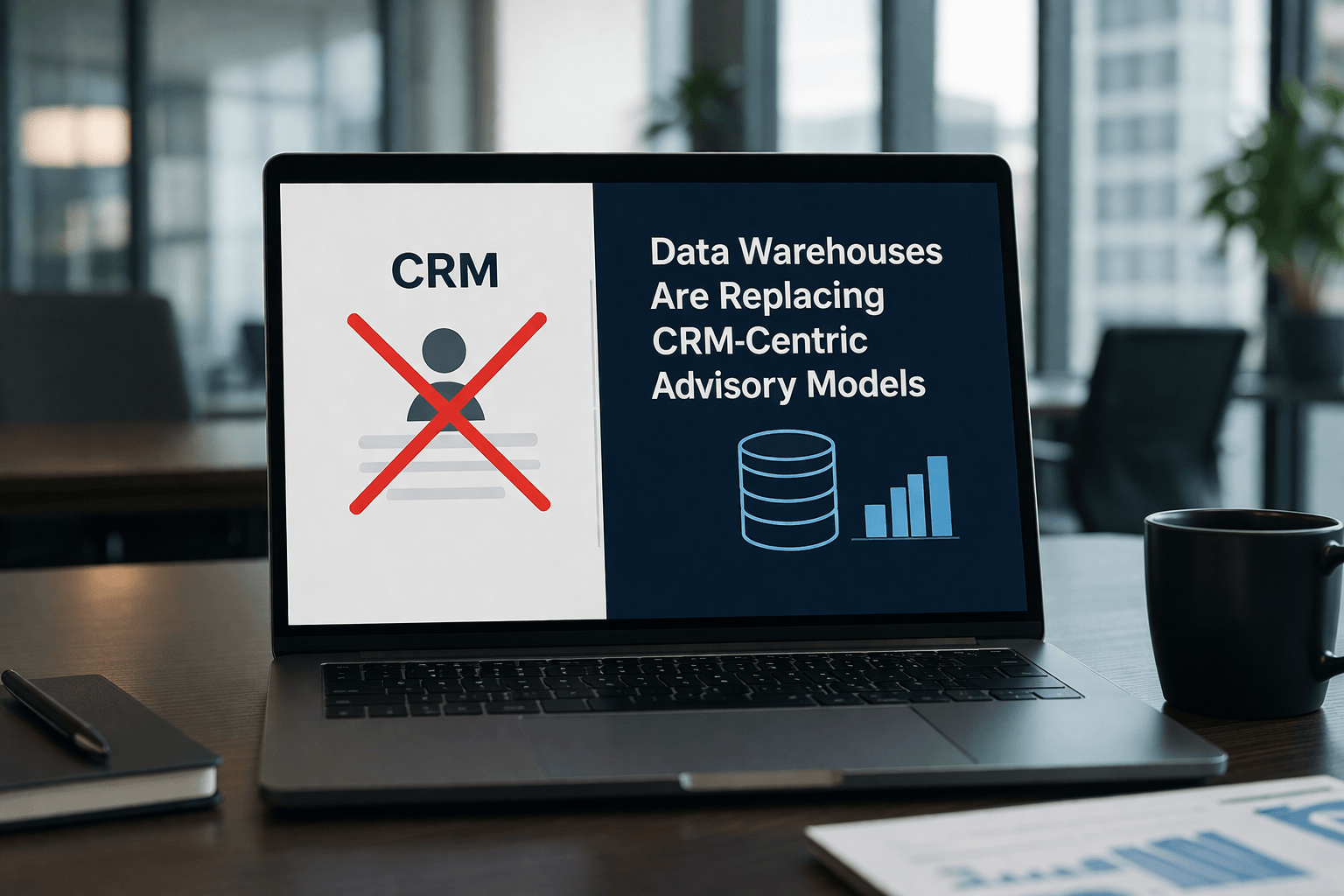
Why Data Warehouses Are Replacing CRM-Centric Advisory Models
For more than two decades, customer relationship management (CRM) systems have served as the operational backbone of financial advisory firms. But the industry has changed.
Introduction: The Structural Shift in Wealth Management Technology
For more than two decades, customer relationship management (CRM) systems have served as the operational backbone of financial advisory firms. From tracking client interactions to managing workflows, CRMs became synonymous with “client-centric” operations.
But the industry has changed.
Today’s advisory environment is defined by fragmented data sources, increasing regulatory complexity, personalized investment expectations, digital client engagement, and multi-generational wealth planning. In this new landscape, the CRM is no longer sufficient as the core system of intelligence.
A structural shift is underway: data warehouses are replacing CRM-centric advisory models.
This does not mean CRMs are disappearing. It means they are no longer the central source of truth. Instead, they are becoming one of many applications layered on top of a unified data foundation.
This article explores why this transition is happening, what it means for advisory firms, and how data warehouses unlock scalable growth, operational efficiency, and advanced analytics.
The Limits of CRM-Centric Advisory Models
CRMs were designed primarily to track interactions and manage sales pipelines. They were not architected to:
- Aggregate high-volume market data
- Process complex portfolio analytics
- Store structured and unstructured financial datasets
- Enable advanced predictive modeling
- Support enterprise-grade reporting across multiple systems
As advisory firms expanded their technology stacks—adding portfolio management systems, financial planning software, custodial feeds, alternative investment platforms, risk tools, and compliance monitoring systems - the CRM became increasingly overloaded.
The result is a familiar pattern:
- Duplicate data entry
- Inconsistent client records
- Siloed reporting
- Manual reconciliations
- Limited real-time insight
When the CRM becomes the “hub” for data aggregation rather than a workflow interface, performance and reliability suffer.
What Is a Data Warehouse in Wealth Management?
A data warehouse is a centralized repository designed to store, standardize, and organize large volumes of structured data from multiple sources.
Unlike operational systems, a warehouse is built for:
- Data integration
- Historical storage
- Complex querying
- Business intelligence
- Advanced analytics
- Machine learning readiness
In wealth management, a modern data warehouse integrates:
- Custodial transaction feeds
- Portfolio accounting systems
- Market data providers
- CRM data
- Financial planning outputs
- Risk analytics
- Client behavioral data
- Compliance logs
The warehouse becomes the firm’s single source of truth. Applications—including CRM systems—then connect to this unified data layer.
Why the Shift Is Accelerating Now
Several structural forces are accelerating the adoption of data warehouses.
1. The Explosion of Data Volume
Advisory firms now manage exponentially more data than they did ten years ago. Alternative assets, ESG metrics, tax optimization analytics, and digital engagement tracking all generate large datasets.
CRMs were not designed for this scale.
2. Real-Time Expectations
Clients expect real-time portfolio visibility, personalized alerts, and proactive communication. Delivering this requires synchronized, high-frequency data pipelines that exceed traditional CRM capabilities.
3. Regulatory Pressure
Regulators increasingly require auditable records, suitability documentation, and consistent reporting. Data warehouses allow standardized governance and audit trails across systems.
4. AI and Predictive Analytics
AI-driven tools—including co-pilots, risk engines, and behavioral analytics—require structured, clean, centralized data. Without a warehouse, advanced AI initiatives are fragmented and unreliable.
CRM-Centric vs. Data-Warehouse-Centric Architecture
Understanding the difference clarifies why this transformation is strategic rather than technical.
CRM-Centric Model
- CRM as a system of record
- Other applications push data into CRM
- Reporting generated primarily within CRM
- Limited scalability for analytics
- High manual intervention
Data-Warehouse-Centric Model
- Warehouse as a system of record
- All systems feed into the centralized data layer
- CRM consumes standardized data
- Business intelligence tools query the warehouse
- AI models trained on unified datasets
- Minimal manual reconciliation
In the warehouse-centric model, the CRM becomes a user interface rather than a data engine.
Growth Advantages of a Data Warehouse Strategy
The shift is not merely operational. It directly impacts firm growth.
1. Scalable Personalization
With unified data, firms can segment clients dynamically based on:
- Net worth thresholds
- Liquidity events
- Behavioral engagement
- Risk tolerance shifts
- Asset concentration
This enables personalized outreach at scale without increasing headcount.
2. Faster Decision-Making
Executive dashboards powered by centralized data allow leadership to monitor:
- Assets under management
- Revenue by segment
- Advisor productivity
- Client retention metrics
- Risk exposures
Real-time insight accelerates strategic decisions.
3. Advanced Revenue Intelligence
Data warehouses allow cross-system revenue analysis, revealing:
- Underutilized product opportunities
- Cross-sell potential
- Fee leakage
- Concentration risk
This drives revenue optimization strategies.
Operational Efficiency Gains
A data warehouse reduces manual tasks across departments.
Automation of Data Reconciliation
Instead of reconciling spreadsheets from multiple platforms, data pipelines normalize information automatically.
Elimination of Redundant Entry
When the warehouse becomes the central repository, duplicate data entry decreases significantly.
Streamlined Reporting
Regulatory, client, and internal reports can be generated from standardized datasets rather than manually assembled files.
Operational efficiency directly improves advisor capacity and reduces overhead.
AI Readiness and Future-Proofing
AI initiatives require high-quality, well-structured data.
Without a warehouse:
- AI outputs are inconsistent
- Insights are siloed
- Models lack historical depth
- Governance risks increase
With a warehouse:
- Machine learning models train on a unified history
- AI co-pilots access contextualized data
- Predictive analytics becomes reliable
- Automation scales responsibly
Firms investing in warehouses today are building the foundation for tomorrow’s intelligent advisory ecosystems.
Implementation Considerations
Transitioning to a warehouse-centric model requires careful planning.
Data Governance Framework
Establish data ownership, validation rules, and security protocols.
Integration Strategy
APIs and ETL pipelines must be designed to ensure consistency and latency control.
Phased Migration
Firms should migrate reporting and analytics functions gradually rather than replacing systems overnight.
Cultural Adoption
Advisors and operations teams must understand that the warehouse enhances—not replaces—their workflows.
Measuring Return on Investment
Key metrics include:
- Reduction in manual data processing hours
- Reporting time savings
- Increase in advisor capacity
- Improved client retention
- Revenue per client growth
- Decrease in compliance incidents
Quantifiable results reinforce long-term commitment.
The Future: Composable Advisory Infrastructure
The advisory technology landscape is moving toward composable architecture—modular systems connected through centralized data layers.
In this environment:
- CRM systems become engagement tools
- Portfolio systems focus on accounting precision
- Planning tools specialize in modeling
- Data warehouses orchestrate intelligence
The warehouse is the strategic core.
Firms that cling to CRM-centric models risk technological stagnation. Those that embrace warehouse-centric architecture position themselves for scalable growth, AI integration, and competitive resilience.